








I am not an optimist. I attempt to have hope, but I was never terribly optimistic, and any inclinations I had in that area died on a very specific day in April, 2020. Maybe this is a dour beginning, but I feel like that’s a thing you should know about your intrepid film reviewer, especially when we’re talking about a very optimistic film. The more overtly sci-fi elements of Project Hail Mary are fine. I can make sense of some technical details, and suspend disbelief for the rest. But it’s the idea that the nations of this world would ever pull together to coordinate and collaborate on a project like Hail Mary that’s a step too far for me.
The idea that we’d work together at all without descending into war—we’ve descended into war like a dozen times since January. The knowledge that the sun was going out? It would be a bloodbath.
This movie asks us to believe that the governments of the world would unite to solve the problem, fund endless brainstorming sessions, and dump all their resources into sending a ship deep into space, funded by the governments rather than private investors jockeying for glory or profit, and crewed by humans rather than malfunctioning, racist AI.
Here’s the other thing I need you to know. I have now seen the film twice. (I will be seeing it at least a few more times in the theater.) When I came out of the second screening, at about 11pm on a weeknight, there was a young person standing with their friend, waving a battered paperback of Project Hail Mary around, telling a friend about every single thing the movie left out.
The friend hung on every word, asked followed up questions, was, as they say, locked in.
Mind you, both of these people repeatedly said they loved the film.
But it was imperative to the first person to make sure the friend knew every single thing that was left out, and the friend was clearly willing to stand there, in the movie theater, as the minutes ticked toward midnight, to let the friend re-tell the story they’d just watched in even more detail.
I fucking love nerds.
And see, this is why I started here. I am not an optimist, but this movie, which is about optimism as a moral imperative as much as its about the other things its about, fully and completely won me over by the time the credits rolled. (Sure there are points where the pacing could be better, and maybe they could have shown a little more of the math onscreen, but to me those were tiny issues in a very moving and funny film.) And then what happened? I walked out into the theater and got to witness the absolute beauty of people being passionate about science, sci-fi, and film.
Because in 2026, with everything else that’s going on, this movie about human ingenuity and friendship and hope can inspire a conversation like the one I saw outside the theater. And by the way, they weren’t the only two—there were other clumps of people talking excitedly and not willing to leave the lobby until they’d hashed out details—it’s just that this particular person brought their book with them, and it made me smile so hard my mask almost split.
So I want to talk about a few things that stood out to me about the film, and offer the comments section to people who want to dive into a spoiler discussion, whether they have their own paperback to hand or not.
The fact that Ryland Grace is a teacher is vitally important here. As his coma-induced amnesia starts to wear off, the first memory he has is of his life as a teacher. Where in the book the first real flashback is of him learning about the Petrova line, here we see him demonstrating sound waves to his students. We fall with him into his memory of standing in a cluttered classroom that was obviously put together by someone who wants to Make Science Fun. Before he’s a scientist, a son, a friend, a concerned citizen of Earth, he’s a teacher in a room full of kids.
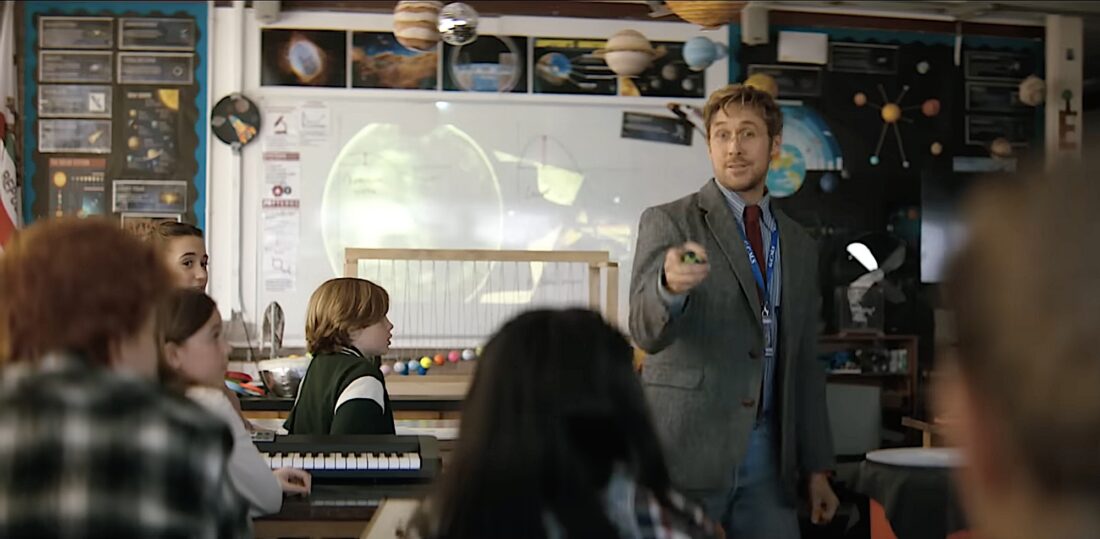
We see everything right here: his genuine care for the students, his curation of his own image as the Cool Teacher, the way he’s genuinely good at his job and the kids genuinely like him, but also how he tries to fob responsibility off when one asks him about the Petrova line. Rather than giving them a scientific assessment, he tells them to ask their parents, despite knowing he can almost certainly explain it better. (In fact, as we soon learn, he’s got a doctorate in microbiology, so even as teachers go he’s extremely qualified.) He tries to break the rules of his own game to avoid being honest with the students, who call him on it. When he finally gives in and explains, however, we see that he’s very good at taking complicated science and breaking it down to its elements.
And this is key, because in the film even more than the book, it’s this enthusiasm and ability to explain that makes him an asset to Project Hail Mary.
He breeds Astrophage because he’s the only one of the hundred of scientists willing to try something silly and build a big dark box out of plywood and duct tape. He listens to ideas from his guard-turned-impromptu-lab-assistant, Carl. He fuels creativity with Twizzlers and shares those Twizzlers with the other guards as well. The good aspects of being the Cool Teacher are what make him great.
This carries over into his relationship with Rocky. He’s spent years taking complex scientific ideas and translating them into words an 11-year-old can understand. It’s not a big leap for him to break ideas down for a person from another world, who has a completely different knowledge base, math base, and system of language from anyone on Earth.
How do Grace and his alien buddy communicate? Through the kind of imitation games you’d play with a child, and then through puppet shows. (Rocky insists they continue the puppet shows even after they can speak to each other.) What’s one of the first things Grace does? Build an instrument that uses soundwaves, to help Rocky “see” stars, planets, and images of life on Earth as the two work together. He prioritizes helping Rocky understand him, and he has exactly the skills he needs to do it.
But they loop the other side of it into this as well. He teaches at a middle school because he fled academia the first time anyone really challenged him. He’s curated a persona as a cool teacher because he can control that persona with an iron fist. Yes he cares about his students, but when Stratt pushes him to go on the mission, he uses them as shields, saying that his “place is in the classroom”—even though he knows that, as little hope as they have now, his kids are all doomed if he doesn’t say yes to the mission.
Unlike in the book, where Grace doesn’t get to have a box of personal items for various vital-to-the-plot reasons, here some other members of the Project have taken the time to pack his stuff, and they seem to consist of absurd Real Genius-inspired nerd t-shirts, and pictures and cards from kids encouraging him to save the world. No books, no photos of family—just mementos of his life inspiring children to care about science. But the movie pulls off the trick of highlighting how important teachers like Grace are, while also showing that in Grace’s case, teaching is a way of hiding from the research career that would have led to conflicts he might not win. (If you’re the teacher, you can always assign more homework or announce a pop quiz if the kids challenge you too much.)
The openness and curiosity that make him a good teacher are at war with his sense of existential dread. Which leads into the other big thing I took away from the movie.
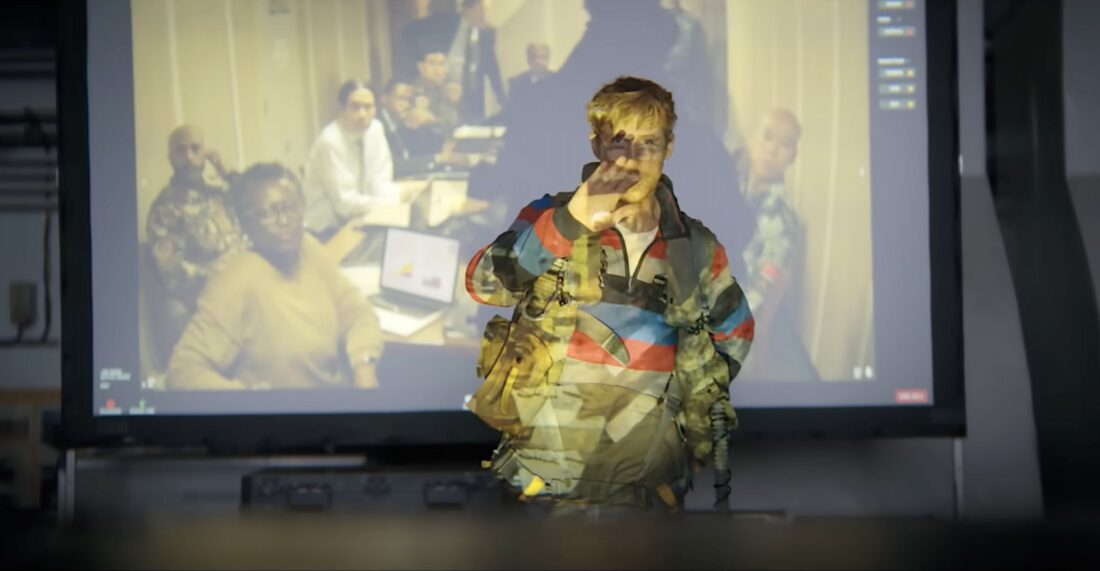
As in the book, Grace’s two big fears are conflict, and death—which I guess is kind of the ultimate conflict. The film shows us the conflict aversion through his interactions with Stratt, where he can’t break through her brusqueness with jokes or pop culture references. He lives his life as the “Homer backing into a hedge” meme. Faced with a room full of colleagues, he whispers ideas and findings, forcing Stratt repeat them into a mic. Finally pushed into the front of the meeting, he makes an awkward 30-plus-year-old pop culture reference in front of an international coalition of people who have gathered to try to save the world against impossible odds.
On the one hand, the movie shows us that this is welcomed—one of the scientists makes the reference back to him, people other than Stratt laugh at his jokes and welcome him into the project with no real resistance. We don’t see it (because the film is already three-hours-and-40 minutes long) but I get the sense that the rest of the group are glad to have someone willing to make jokes and lighten the mood a little.
When he meets the two teams of astronauts, he’s respectful, and switches into teacher mode to impress them with how a miniscule amount of Astrophage can melt a block of steel—a scaled-up version of the kind of thing he’d do to blow his students minds. But he can’t help but bring Commander Yao’s impending death up to him. Faced with Yao’s seemingly peaceful acceptance of his fate, he comes to a dead stop in the middle of the lab, breathing fast, staring at the ceiling, having what looks very much like a panic attack at the thought of what the astronauts were choosing to do as the other Project members flowed around him.
At this point in the movie, Grace is looking back at this moment as the lone person left on the suicide mission—but in the moment itself, he had no idea he’d be the one in space. He’s remembering having a panic attack on someone else’s behalf.

In the karaoke scene we see that Grace sits alone at the bar. He has a beer, he’s listening to people sing, but he’s also clearly working. While the rest of the Project members are in small groups or couples, he holds himself apart. We soon understand why when he goes out to talk to Stratt. He is so overcome with dread for the folks on the suicide mission that he’s shocked that they’re able to sing, laugh, and hook up with each other. For him the idea of their deaths is so overpowering, the fear of their loss so strong, that he can’t bring himself to connect with them. The only person he tries to open up to, at all, is the one person most likely to survive all this—who also just happens to be a person so burdened with responsibility she can’t possibly be open to deep friendship. Assuming everything goes off without a hitch, she’d be heading up Project Hail Mary as the world waits for the “beetles” probes to return to Earth, right? And Grace would presumably be packed off to whatever sorts of science training camps are set up to prepare kids for the post-apocalyptic world they’re about to inherit. Maybe he’d be called back in 15 years time, if he survived that long, and if the probes came back with samples he could work with.
Maybe.
But while all of his actual colleagues are singing together and celebrating the fact that at least for this moment they’re all alive, Stratt is the person he seeks out.
The karaoke scene isn’t in the book, so that’s one change, but the mid-karaoke conversation with Stratt is another big change. To my mind, it’s one of the most significant changes since it casts Stratt’s character in a somewhat different light.
Andy Weir’s book focuses entirely on Grace’s point of view of the Project. We only learn about it through his eyes, and since he’s in an inner circle, we never see how the rest of the world is responding to the sun going out. We never get a temperature check—emotionally speaking—on how Earth’s people are handling their doom, if this has led to an uptick in religious practices, doomsday cults, suicide pacts, etc.
Grace never really looks beyond the Project because he’s busy, and he never gets philosophical about the Astrophage or the end of world because that doesn’t seem to be how his mind works. The only way we get an alternate view is through his memory of the designer of the beetles. The designer is manic, almost wacky, and he sees the Astrophage as a gift from a benevolent divinity because—assuming humanity can survive the sun dimming—we’ll then have access to a nigh-infinite energy source that could lead to world peace and interstellar exploration. In the book the scene is funny, but it’s also an interesting way to show the bone-deep pessimism that Grace has to overcome to commit to the mission. He thinks the other scientist is delusional to see any sort of silver lining, hope, plan, or benevolence in the Astrophage, comes pretty close to saying that, and drops the subject.
Instead of this scene, the one time anyone voices a more cosmic view of the situation, it’s Stratt, of all people. In a conversation that is much more quiet and delicate than the one in the book, and that also stands in stark contrast to the raucous karaoke party inside the hangar, Stratt brings God up, kind of out of nowhere, and Grace is openly startled to learn that she has any sort of spiritual faith. She replies with: “It beats the alternative” which both sidesteps getting too personal, and is also a perfect character moment—of course Stratt would describe her faith as another form of practicality. Grace doesn’t follow up much, just backs out of the moment to go back to his solo seat at the bar.
This moment bleeds into the second half of the karaoke scene, when Stratt contradicts her earlier statement that her team doesn’t need her at the party by gifting them a really cool rendition of Harry Styles’ “Sign of the Times”. Stratt sings, while looking pointedly at Grace a few times, to ally herself with her team. She joins in the celebration of life, rather than continuing to hold herself away as the stoic team leader who’s sending them to their deaths. She realizes that they do need to see her, that Grace needs to see her, and she seems to be explicitly prodding Grace, to get him to listen to the lyric that says “everything is gonna be all right” even as people are preparing for the final show.

Again, I want to reiterate that this is at heart a fun space adventure, but it’s interesting to see how much depth Goddard, Lord, and Miller drew from the novel, and seed into the bones of the movie. Grace can’t really live because he’s too afraid of loss. His fear of death and loss have consigned him to a half-life where he holds all potential connection at arms-length, until he’s presented with a connection that can’t possibly last, and tentatively reaches for it.
In the book, the thing that I found most interesting is that Weir is giving us coward-as-hero, and asking what has to happen to make someone who’s fundamentally a coward a hero. Here the movie draws out some stuff to make it more about why a teacher is the perfect person to send into space, and to look at human (and non-human) connection as the duct tape that hold life together. It asks a blunt question: “Who are you willing to die for?”
It’s a clarifying question, no? Really strips all the bullshit away.
But for the first half of the film, Grace doesn’t have an answer to that question. You can read his memories as him asking: is it my students? Did I make a friend on the ship? Is it Stratt? And then it answers the question with Rocky. (THE BEST ANSWER. I TOO WOULD DIE FOR ROCKY.)
It’s Rocky who asks the other important question: “Why is a schoolteacher in space?”—and while the plot gives us one answer, the story gives us the real answer, which is that Grace’s background as a teacher made him the perfect person to form the friendship that saves at least part of the universe.
The film wobbles between scientific triumph and crushing defeat, between curiosity and pure terror, like a fucking Weeble. In almost every scene, Gosling weaves between some mixture of terror, curiosity, joy, deadpan humor, hope, despair. But it does feel like a weave. The humor isn’t used to undercut tense moments, as in, say, the worst of Marvel, but rather as a path to connection, or a way to process fear. The movie never allows anything to look easy. That scene when Grace has to walk down the long long tunnel to the wall, knowing there’s alien intelligence on the other side, not knowing if it’s friendly or not? That scene is agony. You watch every terrified thought claw its way up into the front of Grace’s brain, and you watch him push each one back down to keep going. He treats Contact like an experiment he’s conducting and pushes through. When he tries to communicate through tapping on the wall between him and his new acquaintance, he defaults to the tones from Close Encounters of the Third Kind, another fundamentally optimistic story about different species learning together. Yes, he’s reaching for a pop culture reference, but in Grace’s mind, he’s whistling in the dark, hoping that the alien on the other side of the wall is friendly.
Because when he’s deep in an experiment he isn’t afraid. When he’s working in front of Stratt and the rest of the world leaders he loses himself in the work. When he makes what is, essentially, First Contact with the Astrophage, he’s not scared—he’s ecstatic. When he loses his three Astrophage, he throws himself right into building a darkroom around them to find them again. Amidst his existential horror at working on a suicide mission, he’s still throwing himself into work everyday, wearing his ridiculous t-shirts. It’s clear that when he gets out of his own head, he really is a great scientist and a great teacher.
The film creates this warp and weave on the macro level, too. We’ll be lost in a scene full of Daniel Pemberton’s (amazing) propulsive music, Rocky’s beautiful warbling, Grace working out an equation aloud, only to cut to the utter, uncaring silence of space. The silence that’s under everything. The void of space, Grace’s death, Rocky’s death, mass extinction, failed planets, dead suns. No matter how fun the movie is, that reality is also always there.
And yes, sometimes, the uncaring void of space is gorgeous, and Greig Fraser’s cinematography underpins the film at every moment.
But it’s still a void.
And because the movie is so full of life, especially when Grace and Rocky are together, the moments of silence are both terrifying and awe-ful, in the old sense of the word. Both times I’ve seen the film so far, the entire audience went dead silent for those cuts.
That’s what’s waiting underneath all the experiments and jokes and karaoke sessions.

Project Hail Mary dramatizes the moment-to-moment choice to face fear, to choose empathy, to try to communicate, to push against that void.
Maybe I’m dwelling on this too much, but I think what’s resonated with me in the days since I saw the movie is how it takes existential panic and makes it… fun? Fun isn’t the right word. It makes it a thing to be worked with rather than against. It works the problem of existential panic. It works the problem of panic, of death, of the uncaring void of space.
And it doesn’t really cheat. Yes, they reconfigure a conversation about faith from the book, yes, “Hail Mary” has a non-sports meaning for some people, and yes, Grace’s name builds on that bit of metaphor—but then that’s it. Once Grace is in space, if the science doesn’t add up there are no miracles to be found. There is no trapdoor, no escape hatch, no moment when love saves the day via an inter-dimensional bookcase—love saves the day in the way it actually does: Rocky loves Grace, and risks his own life to save him, thus saving the mission; Grace loves Rocky, and goes after him even though he thinks it means his own doom, thus saving Erid. Two worlds get a second chance because two very different people learn to talk to each other, and lead with empathy rather than fear.
That’s the optimism of the movie—that humans (and Eridians) can be smart enough to solve the problems that threaten them. The movie shows us this not through lots of onscreen math, or sciencing the shit out of things as in the book, but through treating Grace’s existential terror as a problem to be figured out, and, if not solved, at least worked with enough that you’ll believe in his sacrifices when he makes them. It gives us almost three hours of the belief that empathy and curiosity combined can change lives, that teachers are important, and that friendship can transcend species and save the stars. Project Hail Mary makes me want to suspend my pessimism. It might be a moral imperative.

Thank you for this insightful, thoughtful perspective on the movie, this is amazing and wonderful.
Very nice article.
Love this article! I got a lot of the same things out of this movie, especially the empathy aspect.
“I fucking love nerds.” As we all should!
I think it’s interesting that The Martian also kinda-sorta depends on Earthings coming together to save the day (I think it was India and Russia that come together to provide the ship to save Matt Damon?). But in The Martian we’re invested in him being smart enough to save himself on Mars. I wonder how Andy Weir evolved from writing the one to the other? I’d just be interested in his inspiration for both stories.
Thank you for this insightful essay, and especially for delving into the character of Ryland Grace; it pulled together aspects of the character that I had not fully realized, and others that I had noticed, but was not able to put into words so eloquently.
When my wife and I went to see Project Hail Mary, she loved it . I liked it as well, but I struggled a bit with the character of Grace, especially initially. He seemed a little too goofy for my taste, and in the classroom scene, it was not clear to me whether he was being portrayed as a good teacher or not; nor, until I read this essay, did I fully grasp how much his skills as a teacher played into the rest of the movie, although I probably should have, given who was sitting next to me.
My wife is a former teacher, who spent 20 years as an ESOL teacher (English for Speakers of Other Languages) in public schools and a total of over 30 years as an educator of one form or another. When she suffered a mini-stroke a few years ago that impaired her ability to read, she logged in from her hospital bed to the educational websites that she had been using with her elementary school students less than two weeks before, and worked her way through the same games and exercises that she had given them, to help her regain her writing and math skills. If she had to find a way to communicate with an alien, I have no doubt that she would be able to do so.